When does an aircon really need a gas top-up?
Refrigerant, called gas in everyday use, circulates in a sealed loop between the indoor unit, the compressor and the outdoor unit. In a correctly installed, sealed system it is not used up over time, so an air conditioner does not need a gas refill on a schedule in the way a car needs an oil change.
A top-up only arises when the measured pressure is below the reference level for that gas type and the running conditions. The usual situations are:
- The unit has just been taken down, moved or refitted, and some gas escaped during the work.
- The pipe run was extended beyond the original installation without a matching top-up.
- A joint, the service valve or the pipework has a small leak, so the pressure falls gradually over the months.
- The gas circuit has been opened for an earlier repair.
Is the aircon low on gas, or does it just need cleaning?
Many cases put down to low gas turn out to be a filter, an indoor coil or an outdoor unit thick with dust. When too little air passes over the indoor coil, the unit cools weakly and the coil can ice up, which looks much like low gas. The table is a guide only; a conclusion should wait until the unit has been cleaned and the pressure measured.
| What you notice | Low gas or a dirty unit? |
|---|---|
| Weak airflow, filter covered in dust | Points to dirt. Reduced airflow is the typical sign of a filter and indoor coil blocked with dust. |
| Strong airflow that is not cold | Could be low gas, or a dirty outdoor unit that cannot shed heat. Only a measurement tells which. |
| Ice on the indoor coil | Seen in both cases. If the ice comes back after a thorough clean, low gas is more likely. |
| Frost on the thin copper pipe at the outdoor unit | Usually suggests low pressure; have the pressure measured soon. |
| Musty smell, black spots on the air outlet | A cleaning matter, unrelated to the amount of gas. |
| Weak cooling with an error code on the display | May be a component or a sensor; contact the manufacturer's service centre. |
| Other symptoms: leaking, icing up, not cooling | A separate guide to what you can check yourself before you call anyone. |
How much does an aircon gas top-up cost?
The price is quoted beforehand and applies only when the reading shows the unit is low. There is no charge for measuring the pressure during an aircon cleaning visit.
| Unit or case | Top-up price |
|---|---|
| Wall-mounted, up to 2 HP, R32 or R410A | Top-up from 250,000 VND per unit. |
| Cleaning and top-up together | Cleaning one wall unit of 1–1.5 HP (250,000 VND) and topping up R32 when it measures low (from 250,000 VND): from 500,000 VND for that unit. |
| Ceiling cassette, floor-standing, above 2 HP | Quoted after measuring, because the amount of gas needed varies widely with the unit's capacity and the length of the pipe run. |
| Other gas types, such as R22 | Quoted after measuring and checking the unit's rating label. |
| Gas only, without cleaning | We take bookings for a top-up alone at the price above. The pressure is still measured first, and gas is added only with your approval. |
How does UpClean measure the gas pressure and top up?
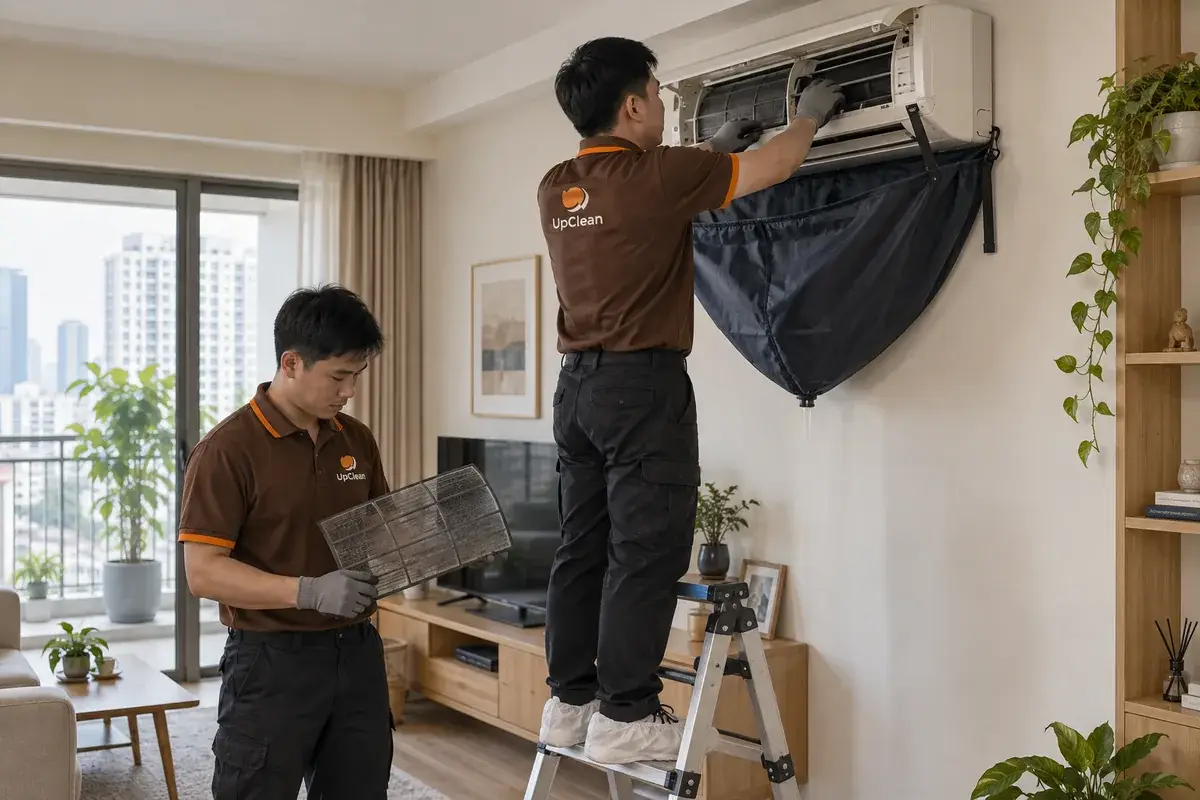
The reading is taken after the indoor and outdoor units have been cleaned and the unit has settled in cooling mode, so that it reflects the gas and not the effect of dust. The Up specialist connects a gauge to the service valve on the outdoor unit, reads the pressure and compares it with the gas type on the unit's rating label and with the temperature of the air coming out.
If the pressure is within the reference range, the reading is recorded in the Up Report (the record with photos sent to you by WhatsApp or Zalo after the visit) and there is nothing to pay. If it is low, the specialist shows you the reading, quotes the top-up and waits for your approval. After the top-up the pressure is measured again, the unit is test-run and the outlet-air temperature is checked before handover.
R32 or R410A: what is the difference, and which does my aircon use?
R410A is a blended refrigerant that was common on many inverter models. R32 is a single-component refrigerant that many manufacturers have moved to for home units. According to figures published by one manufacturer, R32 has a global warming potential (GWP) about one third that of R410A. It is classed A2L, the lower-flammability group in the ASHRAE safety classification, so charging has to follow the correct procedure and be kept away from any flame.
What matters most to a householder is that a unit takes only the gas named on its rating label. The two gases are never mixed, and a unit is never switched to a different gas on anyone's own initiative. The label is on the outdoor or the indoor unit and shows the gas type, and usually the charge amount as well. Recent home units commonly use R32 or R410A; some older ones use R22. The specialist checks the label before proposing a top-up.
What happens if a gas leak is suspected?
UpClean is a cleaning company and does not repair air conditioners. We do not trace or seal leaks and do not replace parts. When a low reading comes with signs such as an oil mark at a joint, unusual frost, or pressure that is low again compared with the previous reading, the specialist writes the observation and the reading in the Up Report and advises you to contact a repair service or the manufacturer's service centre.
You can still decide whether to have a temporary top-up. We will tell you plainly that the added gas may go on escaping until the leak is dealt with. If the pressure drops again a short time after a top-up, a leak is the likely cause and topping up once more does not address it; the readings in the Up Report give the repair service something to work from.
How can I avoid paying for gas the aircon does not need?
A gas top-up is hard for a householder to verify, which makes it easy to propose when it is not needed. A unit that cools weakly because it is dirty is declared low on gas, or the price is charged per PSI of pressure on a basis that is never explained to you. A leaking unit may also be topped up again and again when the pipework should be checked. Whichever company you use, these points help:
- Ask for the indoor unit to be cleaned first and the pressure measured afterwards.
- Ask to see the reading on the gauge and to be told which gas the unit uses.
- Ask the price before any gas goes in, and whether it is charged per unit or by the amount of gas.
- If the unit is low again a few months after a top-up, have it checked for a leak before topping up further.
- Keep the readings to compare at the next service.
Where do you offer gas top-ups, and how do I book?
We take bookings regularly in An Khanh ward (Sala, Thu Thiem, Thao Dien), Binh Trung, Cat Lai, Phu My Hung (Tan My and Tan Hung wards), Thanh My Tay (Binh Thanh), the former Districts 1, 3 and 4, the former Phu Nhuan and Nha Be. The city replaced its districts with wards on 1 July 2025, and we use both names because most people still search by district. Districts 5, 6, 8, 10, 11 and 12, Go Vap, Tan Binh, Tan Phu, the former District 9, Binh Tan and Hoc Mon are also accepted, with the time slot confirmed when you book. Visits run from 7:00 AM to 8:00 PM, seven days a week.
- Call or message 0773 521 104 (phone, WhatsApp or Zalo) with the number of units, their type, where the outdoor unit sits, the name of your building, and whether you want cleaning with a gas check or a top-up alone.
- You receive the price in advance and a written confirmation; we send the specialist's name and photo before the visit.
- At the visit you are given the pressure reading. If the unit is low, you see the quote and decide.
- After the walk-through you pay by bank transfer or cash and receive the Up Report by WhatsApp or Zalo.