What does post-construction cleaning involve? The 12 steps
A home that has just been handed over or fitted out holds far more fine dust, paint and adhesive than a home that is lived in. We divide the work into 12 steps in a fixed order, and each starts only when the one before is finished, so dust does not return to surfaces already cleaned.
- Step 1, survey: on site or from photos and video. We assess the dust and residue and send an all-inclusive quote before you book.
- Step 2, building management: you receive in advance the names and photos of the Up specialists, our trained and identity-verified cleaners, to register access and book the lift if your building requires it.
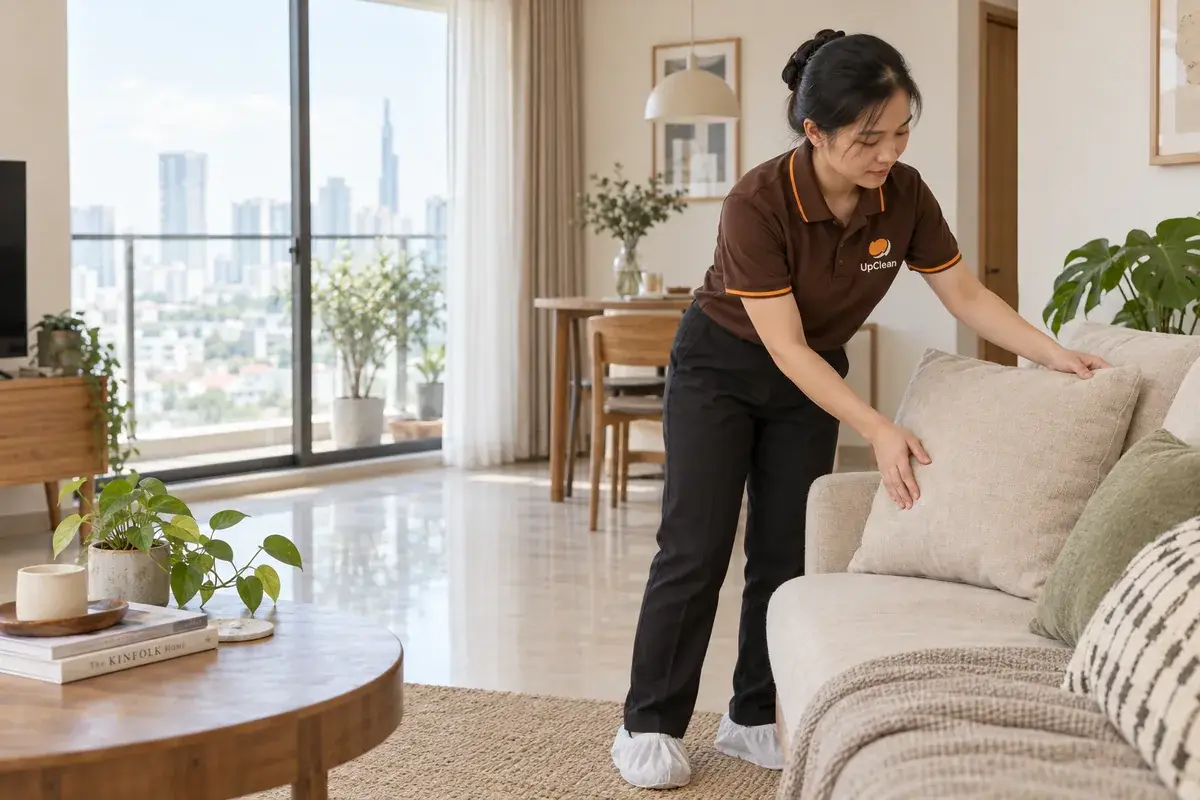
- Step 3, protect and record: shoe covers on, timber floors and newly fitted appliances covered, every area photographed.
- Step 4, site waste: packaging, tape, protective film and small offcuts gathered up.
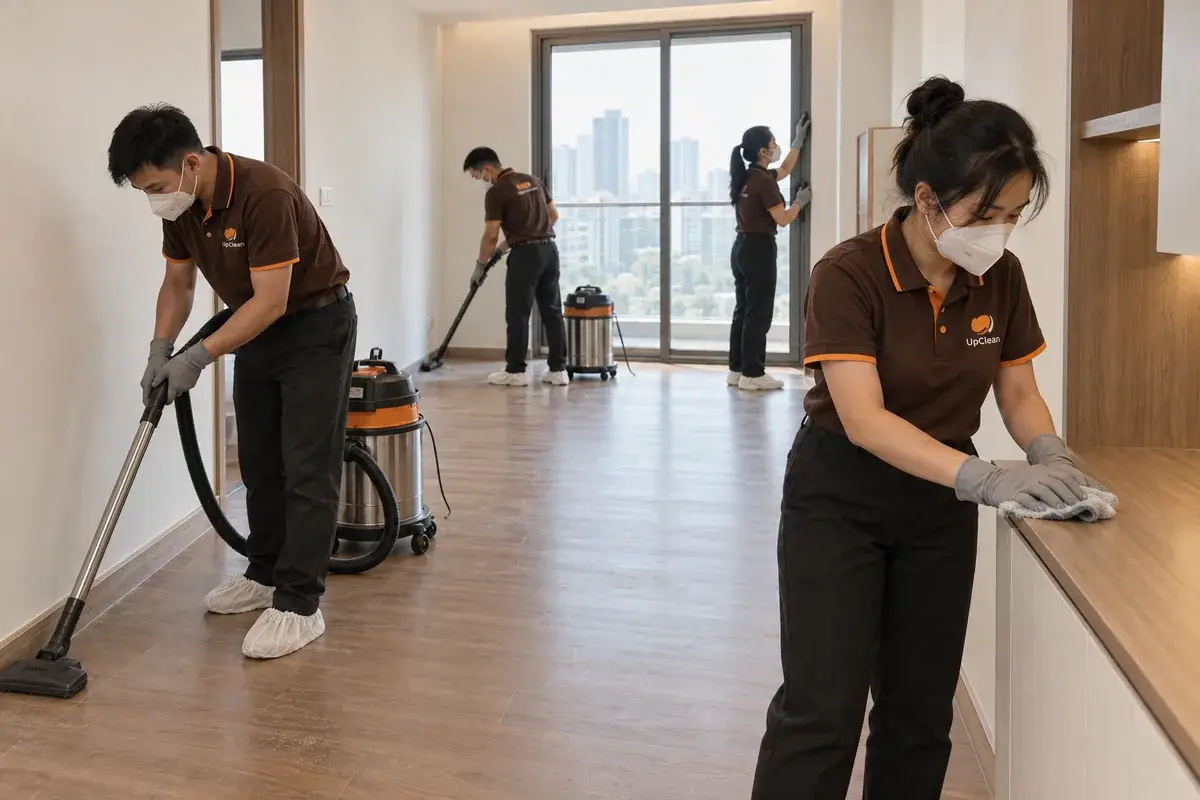
- Step 5, dry vacuuming from the top down: ceilings, lights, walls and door frames, then floors, with a specialist vacuum.
- Step 6, paint, adhesive and cement: lifted from glass, tiles and sanitaryware with tools and a technique for each material.
- Step 7, glass and doors: glass, aluminium frames and railings wiped; sliding-door tracks, where dust lies thickest, cleaned out.
- Step 8, kitchen and built-ins: kitchen cupboards, built-in wardrobes and empty shelves wiped inside and out; worktop and sink cleaned.
- Step 9, bathrooms: sanitaryware, shower screens, mirrors and tile grout.
- Step 10, finishing details: door leaves, handles, switches and sockets.
- Step 11, floors: wet-mopped repeatedly until no white film is left, then every room is checked again.
- Step 12, walk-through and Up Report: sign-off on site or by video call. The Up Report, our photo report, shows each area before and after and notes any finishing defects we saw.
How much does post-construction cleaning cost in Ho Chi Minh City?
Post-construction cleaning is 22,500 VND per m² of floor area for an apartment, 25,500 VND for a townhouse and 30,000 VND for a villa, and never less than 1,350,000 VND per visit. The figures in the table are examples for common floor areas. Your price is confirmed after the survey, because the amount of dust and residue differs from one site to the next.
| Home and floor area | Post-construction cleaning price |
|---|---|
| 1-bedroom apartment, e.g. 50 m² | 1,350,000 VND (1,125,000 VND by floor area, so the minimum per visit applies); an apartment usually takes one to two days. |
| 2-bedroom apartment, e.g. 70 m² | 1,575,000 VND. |
| 3-bedroom apartment, e.g. 100 m² | 2,250,000 VND. |
| Townhouse, e.g. 150 m² total floor area | 3,825,000 VND; time and team size are confirmed in the quote. |
| Villa, e.g. 300 m² total floor area | 9,000,000 VND; time and team size are confirmed in the quote. |
Why does it cost more than a regular deep clean?
The post-construction rate is 1.5 times the deep cleaning rate for the same type of home. For a 70 m² apartment, a regular deep clean is 1,050,000 VND and post-construction cleaning is 1,575,000 VND. The difference pays for a larger amount of work; it is not a surcharge.
- More passes
- Cement and filler dust covers ceilings, walls, door gaps and cupboard interiors. Each surface is dry-vacuumed and then wiped several times, and a floor passes only when the cloth comes away with no white mark.
- Paint, adhesive and cement
- Scraper blades, specialist tools and the correct angle are needed to lift residue without scratching glass, glazed ceramic or new fittings.
- Inside the cupboards
- Kitchen cupboards, built-in wardrobes and empty shelves are wiped inside and out; a standard deep clean covers the outside only.
- Site waste
- Leftover packaging, tape, protective film and small debris are gathered and taken to the building's collection point.
- Protection for new materials
- Timber floors and new appliances are covered before work starts, and photos of the starting condition are kept for reference.
- Notes on the finish
- Scratches, damp marks and peeling found during the work are recorded with photos in the Up Report.
How are cement dust and paint removed from new floors?
The floor is where construction dust lies thickest, and where the wrong method does the most harm. Cement dust mixed with water turns into a thin slurry that clings to the tile, so the specialist always dry-vacuums thoroughly before any wet mopping, then mops with clean water until the cloth shows no white mark.
- Glazed and porcelain tiles
- Mortar and paint spots are scraped off with a specialist tool held at the correct angle; grout is scrubbed back to its original colour.
- Natural stone: marble and granite
- No acidic cleaner is used on marble, and cement marks are treated spot by spot. Stone that is already dull or scratched needs stone floor polishing, which is quoted separately.
- Timber and laminate floors
- Never soaked, and no water left standing in the joints between boards; adhesive and paint are treated gently so the coating is not scratched.
- Newly laid floors with grout not fully dry
- The specialist checks first. Where the grout is still fresh, that area is cleaned lightly or left for a later date so the finish is not affected.
What should you check when you take handover of a new home?
Once the dust is gone, defects it was hiding become easy to see. While cleaning, Up specialists note the scratches, damp marks and peeling they notice in the Up Report, which gives you a record to raise with the developer or contractor. The list below helps you check further yourself.
The Up Report records only what can be seen by eye within the cleaning scope. It does not replace the technical handover inspection between you and the developer or contractor.
- Glass and frames
- Scratches or cracks in the glass; silicone joints that are open or smeared; sliding doors that run smoothly and latch properly.
- Walls and ceilings
- Cracks, damp stains and paint that is peeling or patchy, above all around windows and on bathroom ceilings.
- Floors
- Chipped tile corners and open grout; timber boards with gaps, swelling or scratches from furniture deliveries.
- Kitchen and cupboards
- Doors out of line, loose hinges, chipped worktop edges; signs of a leak at the sink and tap connections.
- Bathrooms
- Floor water that drains slowly or pools; a shower screen that is firmly fixed; tight seals around the toilet and basin.
- Electrics and water
- Switches, sockets, lights and taps that work normally. Check these with the developer: UpClean cleans and does not carry out technical inspections.
Cleaning, airing out the paint smell, moving in: what is the right order?
Get the order right and you clean once, then move into a home that is ready. The sequence below suits most newly finished apartments and townhouses.
- 1. Finish the building work
- Drilling, cutting and paint touch-ups should be complete before the clean; any work afterwards lays down new dust.
- 2. Post-construction cleaning
- All dust and residue removed; finishing defects noted for the developer or contractor.
- 3. Ventilate and let the paint smell fade
- The smell of paint, and of adhesive in new wooden furniture, fades with time. Ventilate properly, and prefer measures that reduce the smell to tricks that only mask it.
- 4. Aircon cleaning
- Air conditioners that ran during the works should have their filters and indoor coil cleaned before the family uses them every day.
- 5. Bring in soft furnishings
- Sofas, mattresses, curtains and rugs come last, once the dust has been dealt with and the paint smell has eased, so the fabric takes up neither.
- 6. Move in and maintain
- After that, a deep clean every 3–6 months, or the regular schedule of an Up Home plan, keeps the home in order.
Which properties do you clean after building work, and when is the right time?
This service is for spaces where the main building work is finished and the space is about to be used: newly handed-over apartments, apartments just fitted out, townhouses and villas after a new build or renovation, and offices and showrooms after a refit.
The right moment is when drilling, cutting and painting are done and the contractor has cleared the bulk site waste. If trades are still working alongside us, new dust settles on surfaces just cleaned. In that case we suggest moving the date or splitting the job in two, a rough clean and a final clean before move-in day, and the quote says so.
Sites still under structural work, areas without railings, sites without stable power and water, and work from scaffolding are outside this service.
- Handover apartments
- Filler dust, paint on glass, protective film on aluminium frames and appliances; dust inside kitchen cupboards and built-in wardrobes.
- Townhouses and villas
- Several floors, stairs, a light well, a roof terrace; usually split into several visits, floor by floor.
- Offices and showrooms
- Cleaned after a refit, before opening day or handover; weekend visits can be arranged between 7:00 AM and 8:00 PM.
What is not included in the fixed price?
The all-inclusive price covers every cleaning task in the 12 steps above. The items below are outside the standard scope and are discussed with you before any work is done.
- Bulk rubble and leftover materials
- Removed under building management's rules; if there is more than expected, we tell you before going ahead.
- Outside glass and work at height
- Glass that cannot be reached from inside, and places needing scaffolding or access equipment, are surveyed and agreed separately.
- Restoring the polish on stone floors
- Part of our stone floor polishing service.
- Sofa, mattress, curtain, carpet and aircon cleaning
- Charged from each service's own price list; can be booked into the same visit.
- Repairs, paint touch-ups and new silicone
- The responsibility of the developer or contractor; we note them so you can follow up.
Post-construction cleaning in Thu Thiem, Binh Trung and nearby areas
Thu Thiem, in An Khanh ward, and Binh Trung ward have many developments being handed over at present, and this is where we carry out the service most often. A ward is the local unit that replaced the city's districts in July 2025; we still use names such as District 7 because that is what people search for. We also work regularly in Phu My Hung, which spans Tan My and Tan Hung wards in former District 7, in Thanh My Tay in former Binh Thanh, and in Cat Lai, former Districts 1, 3 and 4, former Phu Nhuan and Nha Be commune.
For a site in Districts 5, 6, 8, 10, 11 or 12, Go Vap, Tan Binh, Tan Phu or former District 9, send the address and photos of its current condition to 0773 521 104 on WhatsApp or Zalo; the survey time is confirmed when you book.