How much does sofa cleaning cost in Ho Chi Minh City?
Sofa and couch cleaning is priced by the seat and by the upholstery: 130,000 VND per seat for fabric or microfibre, 160,000 VND per seat for leather, and 50,000 VND for each ottoman or loose cushion. The price is all-inclusive and confirmed before you book. The table applies these rates to common sofa shapes.
The 390,000 VND minimum applies to the visit, not to each piece: every sofa, ottoman and cushion cleaned in the same visit is added together before the minimum is checked. An armchair that belongs to a set counts as one seat. For a chaise end or an unusual size, we confirm the number of seats from a photo. A large set takes longer than a three-seater, and the expected time is given when the booking is confirmed.
| Sofa type | All-inclusive price |
|---|---|
| Armchair, 1 seat | Fabric 390,000 VND (visit minimum). Leather 390,000 VND (visit minimum). |
| Two-seater | Fabric 390,000 VND (visit minimum). Leather 390,000 VND (visit minimum). |
| Three-seater | Fabric 390,000 VND. Leather 480,000 VND. About 60–90 minutes. |
| L-shaped corner sofa, 5 seats | Fabric 650,000 VND. Leather 800,000 VND. |
| L-shaped sofa, 5 seats, with 1 ottoman | Fabric 700,000 VND. Leather 850,000 VND. |
| Living-room set, 3 + 2 + 1 | Fabric 780,000 VND. Leather 960,000 VND. |
| Large corner sofa, 7 seats | Fabric 910,000 VND. Leather 1,120,000 VND. |
What is included in the sofa cleaning price?
The per-seat price covers one complete visit by an Up specialist, an identity-verified cleaner trained to the Up Standard. Nothing below is charged separately.
- Before work starts
- We confirm the seat count and material from your photos, send you the specialist's name and photo, and photograph the sofa as found.
- During cleaning
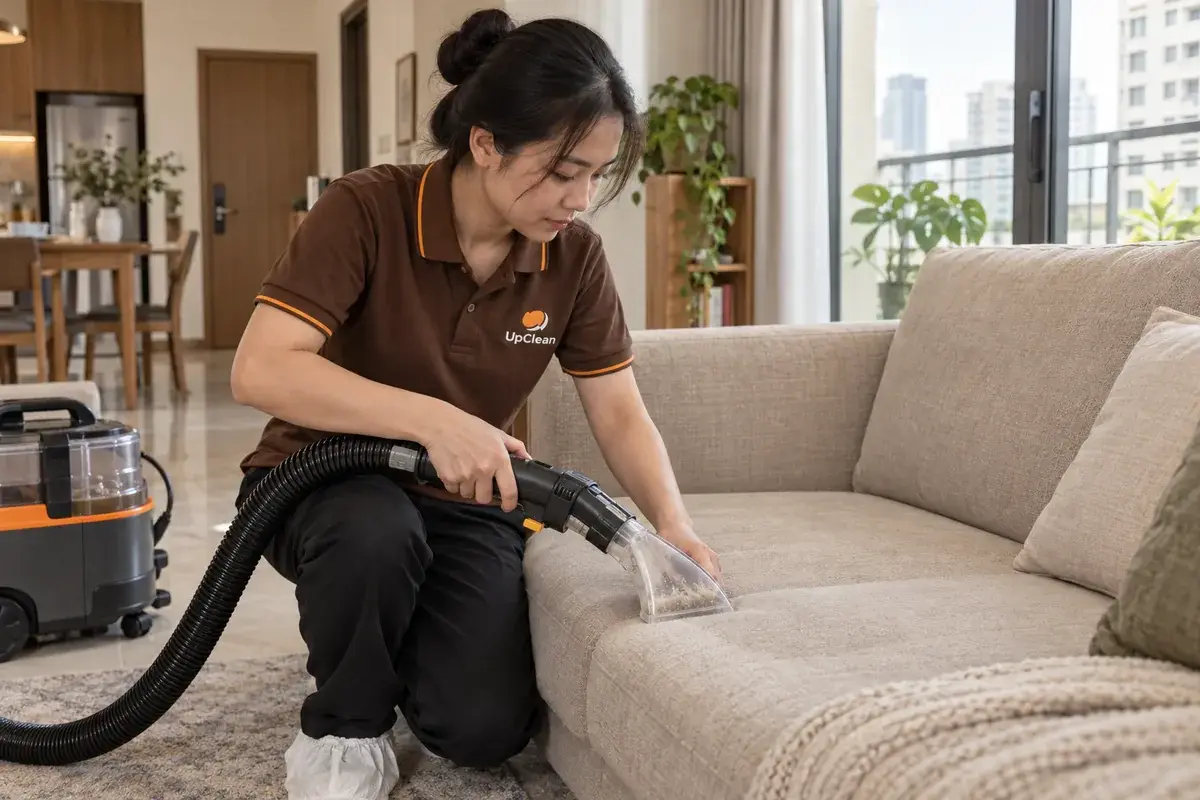
- We cover the floor and nearby furniture, test colourfastness on a hidden spot, use a separate solution for fabric and for leather, and recover the dirty water with the extraction machine.
- Afterwards
- The pile is brushed, cushions go back in place and you check each seat with the specialist in a walk-through. The Up Report, a photo record of the visit, follows by WhatsApp or Zalo.
- If something is not right
- Reply to the Up Report within 48 hours and any item that falls short is redone free of charge. If the specialist arrives more than 15 minutes late, that visit's invoice is reduced by 10%. No cost is added without your written agreement.
- Payment
- After the walk-through, by bank transfer or cash. A VAT invoice is issued on request.
Fabric, velvet, leather or suede: how is each type of upholstery cleaned?
Each covering reacts differently to water, heat and brushing, so the specialist identifies the material before choosing the solution and the technique.
| Material | How it is cleaned |
|---|---|
| Woven fabric (polyester, cotton, blends) | Suited to spray extraction, with the water limited so the foam underneath does not soak. Natural fibres such as cotton and linen shrink and water-mark more easily, so they are tested with extra care on a hidden spot. |
| Microfibre | A smooth surface that holds sweat marks and fine dust. After cleaning, the pile is brushed in one direction so the colour dries even, without patches. |
| Velvet | The pile flattens and changes sheen with water or brushing. Send a close-up of the fabric and the care label first; we take the job only once the material is clear. |
| Genuine leather | Never spray-extracted. It is cleaned with as little moisture as possible, then conditioned to keep it supple and preserve its natural sheen. |
| Faux leather (PU, leatherette) | While the coating is intact, the method is the same as for genuine leather. Where the surface has cracked or peeled in patches, cleaning tidies the sofa but cannot join the coating again; send a photo for advice first. |
| Suede and nubuck | The napped surface takes up water very quickly, marks easily and can stiffen. These sofas are always assessed first, from photos or on site, and a method is proposed only when it is safe for the material. |
| Mixed materials | For example a leather frame with fabric seat cushions: each part follows the procedure for its own material, and the price is agreed from photos before booking. |
Common sofa stains: what to do straight away, and what cleaning can remove
Most stains are far easier to treat when they are blotted dry early. The table gives the first step you can take yourself and the result a specialist usually achieves.
| Stain | First step and usual result |
|---|---|
| Coffee, tea, soft drinks | Blot with a dry white cloth, pressing from the edge towards the centre; do not rub. Fresh spills usually come out completely. Old ones with a brown ring need several rounds of spot treatment. |
| Milk and children's food | Lift solids with a spoon and blot the rest. Avoid hot water, which can set the stain. The sour smell usually drops noticeably after cleaning. |
| Grease and sauces | Blot with dry kitchen paper only. Rubbing in water or neat washing-up liquid spreads the mark. |
| Sweat and body oils | They build up unnoticed on arms and headrests over months. Regular cleaning lightens these darkened areas considerably. |
| Ballpoint and felt-tip ink | Do not use alcohol or bleach on coloured fabric yourself. The result depends on the ink and the material; the specialist tests first and tells you how far it can be recovered. |
| Pet urine | Blot until dry and tell us where it is when you book. Fresh accidents respond well; urine that soaked into the foam long ago may leave a faint smell. |
| Water rings | They usually follow wiping with a cloth that was too wet. Cleaning the whole cushion face evenly fades the outline. |
Sofa dry cleaning or spray extraction, and how long does a sofa take to dry?
UpClean cleans fabric sofas by spray extraction: the solution is sprayed into the weave and drawn straight back out with the dirt, with the water limited so the seat is only slightly damp at handover. Fabric is usually dry in 4–6 hours in a ventilated room or with the aircon or a fan running. Leather is cleaned with very little moisture and can be used after about 30 minutes, once the conditioner has been absorbed.
What is sold as sofa dry cleaning is usually a low-water method: foam that is brushed in and vacuumed off, or a fast-evaporating solution wiped over the surface. It freshens the surface, but dirt that has worked into the fibres and the foam underneath is hard to draw out that way. Our leather method is close to what most people mean by dry cleaning. When a material cannot take water, the specialist says so and proposes a safer method.
Keep children and pets in another room until the fabric is dry, so that no pressure marks or new stains are left.
Can I clean my sofa myself?
Day-to-day care is yours to do. Deep cleaning is different: it needs a machine that pulls the dirty water back out of the fibres, and experience in reading the material. Without them the foam holds moisture, smells develop and water rings appear.
- Safe to do yourself
- Vacuum the seats and crevices every week with a soft brush head, blot spills as they happen, and wipe leather with a well-wrung damp cloth or dust it with a soft dry one. Turn and rotate loose seat cushions every few weeks so the fabric wears evenly.
- Better avoided
- Spraying a lot of water or soap onto the cushions, machine-washing cushion covers, drying with heat, and using bleach or alcohol on coloured fabric.
- Shop-bought sofa cleaners
- Test on a hidden spot and use little. Most water rings on fabric sofas come from too much water or strong detergent with no extraction machine to recover it.
- Between cleans
- Put a thin washable throw where pets lie and wash it often. Keep the sofa away from damp walls and the direct airflow of the aircon, and draw the curtains when the sun falls straight on it. On leather, use only conditioner made for leather, tested on the back first. Keep the care label, usually sewn under a seat cushion: its symbols help the specialist choose the method.
- Sofa and mattress cleaning in a humid climate
- Our longer guide to care-label codes and spot cleaning at home.
How often should a sofa or couch be cleaned?
Every 6–12 months suits a sofa in daily use. A simple test for fabric and microfibre: wipe a slightly damp white cloth over an arm or a headrest. If it comes away grey, there is enough dust and body oil for a deep clean to make a visible difference. Do not try this on velvet or suede.
| Household | Suggested interval |
|---|---|
| Small household, moderate use | About every 12 months. |
| Daily use, frequent guests | Every 6–12 months. |
| Young children, dogs or cats | About every 6 months, with spot treatment in between when needed. |
| Leather sofa | Clean and condition every 6–12 months; sooner if it stands by a sunny window. |
| Rental apartment | At each change of tenant, before the next viewings. |
Which areas of Ho Chi Minh City do you cover, and how do I book?
Up specialists clean sofas regularly in An Khanh and Binh Trung wards (the former District 2, including Sala, Thu Thiem and Thao Dien), in Phu My Hung (Tan My and Tan Hung wards, former District 7) and in Thanh My Tay ward (former Binh Thanh), and also in Cat Lai, the former Districts 1, 3 and 4, the former Phu Nhuan and Nha Be commune. Bookings are accepted in Districts 5, 6, 8, 10, 11 and 12, Go Vap, Tan Binh, Tan Phu and the former District 9 as well, with the time slot confirmed when you book. The city replaced its districts with wards on 1 July 2025, but most people still use the district names.
The UpClean office is at 72 Nguyen Co Thach in the Sala urban area. Bookings are taken from 7:00 AM to 8:00 PM, seven days a week, by phone, WhatsApp or Zalo on 0773 521 104, and quotes, confirmations and the Up Report can all be in English. Before the visit, put away personal and fragile items around the sofa and leave a power socket free nearby. If your building asks residents to register outside staff, we send the specialist's name and photo in advance so that you can do it. Some districts have their own page, linked under the price table.
- Get a quote
- Send the number of seats, the material and a photo.
- Book a visit
- We confirm in writing by WhatsApp, Zalo or email and send a reminder the day before.