What is woodworm, and why does furniture get it?
Woodworm is the everyday name for several small beetles whose larvae live and feed inside timber. The adult appears only briefly, to mate and lay eggs in holes, cracks or open grain. Most of the damage is done by the larvae, which tunnel through the wood, sometimes for many months before anything shows on the surface. Woodworm does not bite people; the concern is that timber weakens from the inside and that the insects can spread to other pieces if left.
When a larva becomes an adult it bores its way out, leaving a small round hole and a deposit of fine wood powder. Guidance from UC IPM, the pest management programme of the University of California, puts the exit holes of powderpost beetles at about 1/32 to 1/8 inch across, from under 1 mm to about 3 mm, with powder as fine as flour or talc.
The timber most often affected was not treated properly when it was processed, is kept somewhere damp, or is bare wood with no paint or varnish; woven rattan and bamboo pieces are affected too. Woodworm also arrives in second-hand furniture, pallets and wooden crates, so look over anything bought used before it stands next to pieces you value.
What is the difference between termites and woodworm?
Small round holes and fine powder point to woodworm; mud points to termites. The two are different insects that live differently and need different treatment, so telling them apart is the first job of the survey. If it turns out to be termites, we advise you under our separate termite control service.
| Insect | Signs it leaves |
|---|---|
| Woodworm | Small round holes with clean edges on the surface, and very fine wood powder that collects in small piles. It usually stays within one piece of furniture or one board. |
| Subterranean termites | Mud tubes running along walls and door frames, timber eaten hollow from the inside and mixed with soil, and shed wings around lights after rain. The colony lives in a nest and can spread through the whole house. |
| Drywood termites | They need no soil. They leave small, loose pellets of droppings that look like grains of pepper, unlike the fine powder of woodworm. |
| If you are not sure | Leave everything as it is, do not sweep up the powder or disturb the traces, take close-up photos and send them to 0773 521 104 on WhatsApp or Zalo for a first opinion. |
What should I do if a wardrobe or cabinet has woodworm?
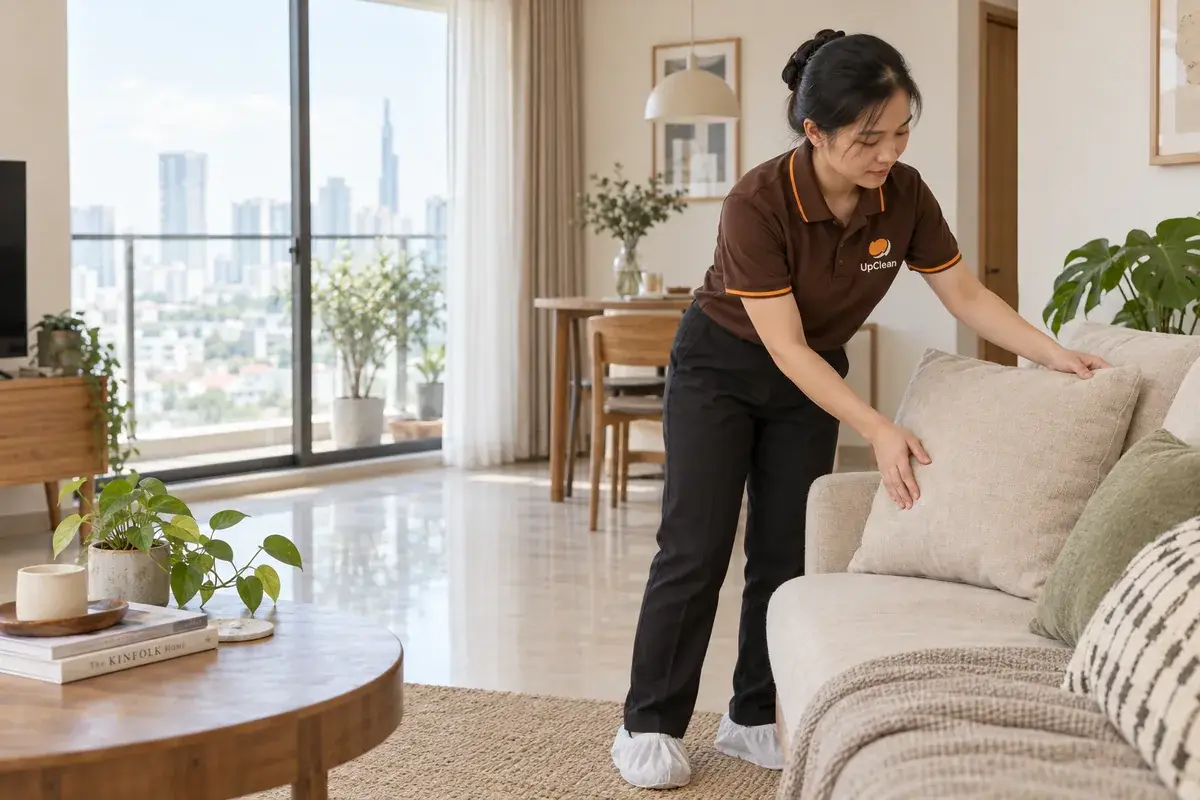
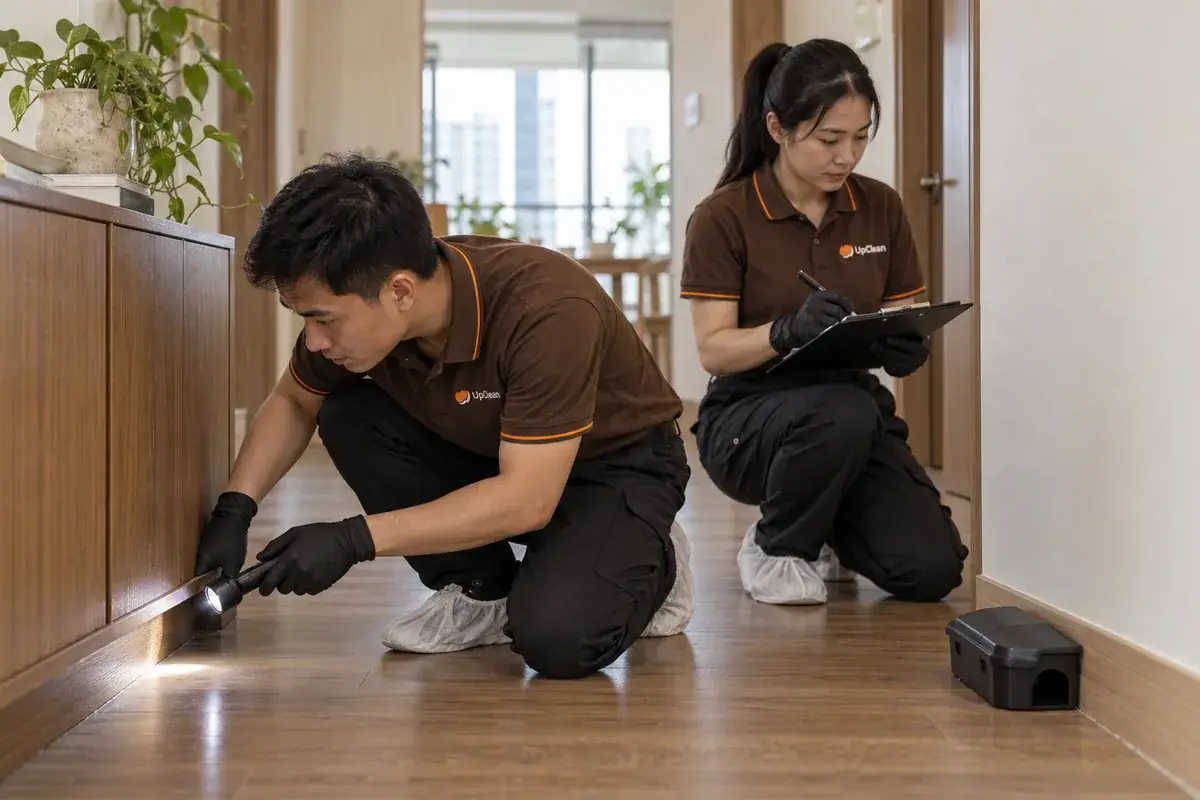
Empty it, mark what is there and send photos. Take out clothes and papers and put them in sealed bags, vacuum up the powder, mark the existing holes and photograph them for UpClean. At the survey the technicians judge how far the woodworm has gone, check the timber pieces standing nearby, and propose either treating the piece where it stands or separating it if it is heavily infested. The Up specialist, the UpClean staff member who looks after your home during the visit, covers the floor and walls around the piece, vacuums up the powder after treatment and puts the contents back once that is permitted. Timber that has rotted and can no longer bear weight is recorded, so that you can discuss replacing it with a carpenter.
Wardrobes and bookshelves are among the pieces where woodworm appears most often, because the back and the inside are usually left bare and the piece is seldom moved. Some people hear a very faint ticking in the wood at night. That can be larvae boring, but it can also be the wood moving as the temperature changes. New holes and fresh powder under the piece are the more reliable sign.
Which furniture gets woodworm, and how is each piece prepared for treatment?
Each kind of timber item is prepared differently. The Up specialist always asks first about the finish and the value of the piece, photographs it as found and moves it only with your consent.
| Item | How it is prepared |
|---|---|
| Solid-wood wardrobes, beds, tables and chairs | Clothes, books and papers are put into sealed bags and the floor around the legs is covered. The back and underside are checked too, since that is where timber is usually left unpainted. |
| Timber doors, door frames and staircases | Nearby walls, stone floors and handrails are covered, and the holes on treads and door faces are recorded so that they can be monitored after treatment. |
| Timber floors | The area with fresh powder and any weakened boards are identified. Boards are lifted, if that is needed, only with your written agreement. |
| Antiques, lacquerware and altar pieces | The method that disturbs the surface least is preferred, and the risks are discussed with you before you decide. |
| Rattan, bamboo and picture frames | Small items are usually separated for treatment. For a badly damaged piece we may advise replacing it instead of treating it. |
Who carries out woodworm treatment, and who looks after my home?
You deal with one company throughout. Applying insecticide products in a home is a regulated activity in Vietnam, so that part is done by UpClean's own pest-control technicians, as the product label and the regulations require. Preparation, protection and cleaning are done by the Up specialist.
| Who | What they do |
|---|---|
| UpClean's technicians | Identify whether the cause is woodworm or termites and how much damage there is; propose a method for each piece, in place or separately for a heavily infested one; use only products with a valid registration number in Vietnam, on the permitted list; set the time to stay out of the area; carry out the follow-up checks and the warranty as written. |
| The Up specialist | Books and attends the survey; sends the written proposal with the all-inclusive price; clears and covers; watches over each piece; vacuums up the powder and wipes the timber and the area around it; puts everything back; sends the Up Report, our photo record of the visit; reminds you when a check is due. |
| You | Review and approve the plan; tell us which pieces are precious and which you would be willing to replace; ask to see the product information before the appointment if you wish. |
Is woodworm treatment safe for children, pets and food?
The precautions for your home are set out in writing before the appointment: the areas to be treated, how long to stay out of them and anything specific to your household. All instructions on keeping away, ventilation and when the furniture can be used again come from UpClean's technicians.
- Put away food, dishes and children's toys, cover fish tanks, and move pets to another part of the home for the period you are given.
- Anyone more sensitive (babies, pregnant women, older people, people with a respiratory condition) leaves the area for as long as the technicians ask.
- Do not wash or wipe a treated spot until you are told to. The Up specialist cleans at the right time.
- Do not burn anything or mix chemicals yourself to deal with woodworm. Any product must have a valid registration number in Vietnam, be on the permitted list and be used as its label directs.
Can I treat woodworm myself?
You can monitor woodworm and limit its spread yourself with the safe steps below. The cases listed after them call for technicians.
- Vacuum up the powder, then cover the old holes with paper tape or mark them. New holes or fresh powder a few weeks later show that the woodworm is still active.
- Keep timber furniture dry and aired, away from damp walls and clear of any water leak.
- Paint or varnish bare timber, since a sealed surface leaves fewer places for eggs to be laid.
- Keep an affected piece apart from sound ones.
- When to call in technicians
- Woodworm in several pieces, in doors or in the floor; timber that has already weakened; a piece of high value; or doubt about whether it is woodworm or termites.
How much does woodworm treatment cost in Ho Chi Minh City?
There is no listed price for this service, because every piece of timber is its own case. The survey is free. After it you receive an all-inclusive written quote that lists each item, the method, the time to stay out of the area, the follow-up checks and the warranty terms; the price does not change without your written agreement. The quote is worked out from:
- The number and size of the pieces, and the total area of timber floor and doors to be treated.
- How far it has gone: a few new holes, or timber that is already weakened.
- The method: treatment in place, or separate treatment of a heavily infested piece.
- The finish and value of the piece: lacquer, antique timber and altar pieces call for more care.
- Whether floorboards or door leaves must be taken off, or bulky furniture moved.
- How much emptying of cupboards, vacuuming and wiping the Up specialist has to do.
Which areas of Ho Chi Minh City do you cover for woodworm treatment?
Woodworm surveys are arranged regularly in Sala, Thu Thiem and Thao Dien (An Khanh ward), Binh Trung ward, Phu My Hung, Thanh My Tay, Cat Lai, Nha Be commune, and former Districts 1, 3 and 4 and Phu Nhuan. The city replaced its districts with wards in July 2025, but people still use the district names, so we do too. In Districts 5, 6, 8, 10, 11 and 12, Go Vap, Tan Binh, Tan Phu and former District 9, message 0773 521 104 on WhatsApp or Zalo and the survey date is confirmed when you book. Besides homes, we survey timber in offices, shophouses and restaurants.
- Termite control
- For mud tubes, timber hollowed from the inside or winged termites after rain.
- Guide: termites in Saigon houses
- The signs, what treatment involves and what to ask before you sign.
- Pest control
- For cockroaches or ants found at the same survey; the work is written into one document and scheduled for the same visit where suitable.