German or American cockroach: which one is in my home?
Two species account for most cockroaches in Ho Chi Minh City homes, the German and the American. They differ in size, in where they live and in how they get in, so the treatment plan differs too. Naming the species correctly is the first step towards a result that lasts.
- German cockroach
- Small and light brown, with two dark stripes running lengthwise on its back. It lives almost entirely indoors, in warm places close to food: kitchen cabinet hinges, the gap behind the microwave, the fridge motor, the dishwasher. It breeds fast, and the female carries her egg case until shortly before it hatches, so by the time you see young ones the population may already be large.
- American cockroach
- Large and reddish brown, often called the sewer cockroach. It lives mainly in sewers, drain pits and basements, and comes in through floor drains and waste pipes to bathrooms and laundry areas. It is common in townhouses and at ground level in villas, or where a floor-drain grate leaves a gap.
- Signs both leave
- Droppings like ground pepper or small black smears, empty egg cases, shed skins and a musty smell. Cockroaches are active at night; seeing them in daylight usually means the hiding places are full.
Where do cockroaches hide in a house or apartment?
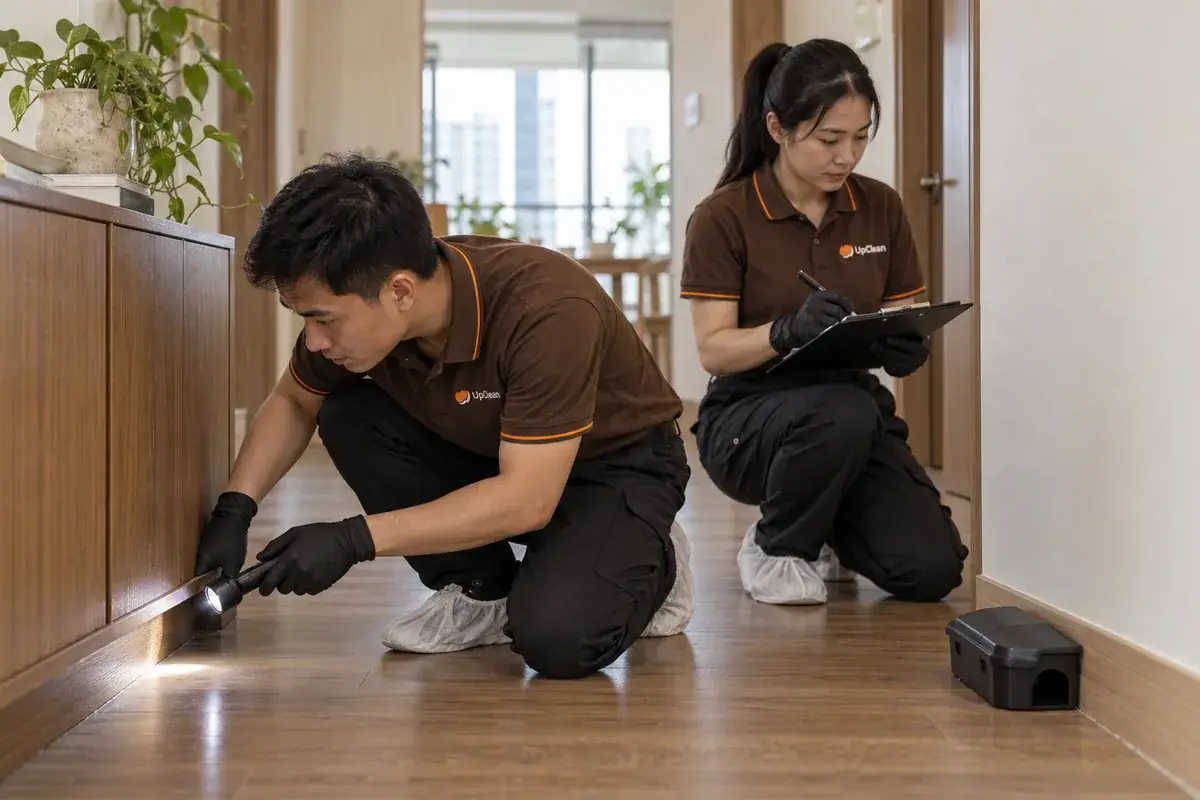
They gather somewhere enclosed, warm and close to water and food, and that is where adults, young and egg cases are found together. A small cockroach about the length of a finger joint, running fast around the kitchen, is usually a German cockroach or the young of a larger species; two dark stripes on the back make it almost certainly German. UpClean's technicians check these places first:
- Hinges, inside corners and undersides of kitchen cabinets, and the gap between cabinets and the wall, especially behind a dishwasher or built-in oven.
- The fridge motor compartment and door seals, and the backs of microwaves, rice cookers and coffee machines.
- Under the sink, around the waste pipe, and at floor drains in the kitchen and bathrooms.
- Service ducts, the refuse-chute door, electrical sockets and recessed light housings near the kitchen.
- Cardboard boxes, paper bags and stacks of old newspaper kept for a long time in a storeroom or under the stairs.
Why does a clean apartment still get cockroaches?
Because cockroaches move between apartments through shared voids and are carried in with boxes and bags. High-rise buildings have service ducts, refuse chutes and pipework shared between floors, and cockroaches move along these voids from one unit to the next. A well-kept apartment can therefore still get them, particularly when a neighbouring unit or a common area has cockroaches.
They also come in with cardboard boxes, shopping bags and second-hand household appliances. Kitchen cabinets made of engineered board with many joints, built-in appliances that give off heat and a sink that is always damp give them the shelter they look for. In an apartment, UpClean's survey includes the floor drains and service-duct doors, and notes any points in common areas so that you can raise them with building management.
Are shop-bought cockroach baits and traps enough?
They are a sensible choice when you see a cockroach only now and then, and they often fall short beyond that. Bait tablets, ready-made bait boxes and sticky traps can reduce the number of cockroaches moving about. Their limits are that they tend to be put where they are easy to see instead of where cockroaches shelter, there are too few for a whole kitchen, and they are seldom topped up at the right time. With German cockroaches, which breed fast, the population can recover within a few weeks.
Thorough control needs three things together: the species and its hiding place correctly identified; bait or treatment applied at the right points and in the right amount under the plan that follows the survey; and food and shelter removed by cleaning the kitchen properly. Follow-up visits find any point that is still active so it can be topped up in time, before cockroaches are numerous again.
Gel bait or residual spraying: how is cockroach treatment done?
The choice rests with UpClean's technicians once they have seen the home. In outline, these are the usual approaches:
- Gel bait
- Small drops of bait placed in cracks, on hinges and under shelves, where cockroaches go. They feed and return to their hiding place, and the effect passes to others. There is little odour and no broad spraying, and the household usually only needs to stay out of the area for a short time, which suits a kitchen in daily use. Results take a few weeks to show clearly, and bait is topped up at follow-up visits.
- Residual spraying
- Product applied to wall gaps, the underside of cabinets, the base of walls and around floor drains, leaving a deposit on the routes cockroaches use. It is typically used for American cockroaches coming from drains, for outdoor areas, or when numbers are high. Surfaces are covered carefully and the household keeps away for the full time the technicians specify.
- Combined
- German cockroaches that have spread widely usually need gel bait in the kitchen cabinets and residual treatment in damp areas, with follow-up visits under the approved plan.
- One thing to avoid
- Do not use a household insect spray on points where bait has been placed. The smell can make cockroaches avoid the bait and weaken its effect.
What happens in the kitchen before and after treatment, and is it safe for children and pets?
The kitchen is cleaned thoroughly before treatment and food-contact surfaces are wiped again afterwards, with the bait points left alone. This cleaning is central to how UpClean works, because bait only does its job when cockroaches have no easier food.
- Before treatment
- Cupboards are emptied, crumbs vacuumed out, and grease wiped from the inside of doors and from drawer runners. The spaces under the fridge and sink and the gap between hob and cabinet are cleaned, and accumulated cardboard boxes and paper bags are removed.
- During treatment
- Food, dishes, chopping boards, knives and children's items are shut away or moved out of the kitchen. Your Up specialist stays on site and records every bait point.
- After treatment
- Worktops, the dining table and dish racks are wiped as the technicians advise. Hinges and cracks holding bait are not wiped, and everything goes back where it was.
- Children and pets
- Tell us at the survey. The technicians place bait out of reach of children and pets; toys, feeding bottles and pet bowls are put away; and children and animals keep out of the treated area as the technicians direct. The time to stay away is stated in the plan sent before the visit.
- Add-on services
- Fridge cleaning, cooker-hood cleaning or a deep clean of the home can be included in the same quote.
Cockroach control for restaurant and café kitchens
A commercial kitchen cooks intensively, runs many appliances that give off heat and takes in goods constantly, so cockroaches return easily after a single treatment. For restaurants, cafés and bakeries in shophouses in Sala, Thu Thiem and Phu My Hung, UpClean recommends a survey that leads to a scheduled control plan in place of one-off visits.
- Treatment is scheduled for closing days or quiet hours, between 7:00 AM and 8:00 PM.
- Dry stores, wash-up areas, bar counters and the spaces under cooking equipment are surveyed zone by zone.
- The Up Report, the record we send after each check, states the points treated, which helps the owner keep an internal file.
- Checking goods and cardboard boxes as they come into the store is a habit that helps keep cockroaches from being carried in.
How much does cockroach control cost?
UpClean does not list a rate for cockroach control, because each kitchen needs its own plan. The survey is free. The all-inclusive quote that follows, in writing, lists the method, the areas to be treated, the number of return visits, the scope of cleaning and the warranty terms. The main factors are:
- Species and severity: a few individuals in one cabinet, or young cockroaches throughout the kitchen and bathrooms.
- Type of premises: apartment, townhouse, villa or commercial kitchen, and the number of kitchens, stores and bathrooms to treat.
- The method, and the number of follow-up visits and bait top-ups in the plan.
- How much kitchen cleaning your Up specialist carries out before and after.
- Special hours required by the business or by building rules.
Should I deal with cockroaches myself or call a pest control service?
If you only meet the occasional large cockroach from the drains, you can handle it yourself: keep the floor-drain grates in place, keep the kitchen dry and use a household product with a valid registration number in Vietnam. Read the instructions on the packaging first, store it away from children and food, and never mix products.
Call a cockroach control service when you see young cockroaches or egg cases, when cockroaches appear in daylight, or when they keep returning after several attempts of your own. At that point someone needs to find the hiding place and work to a plan with follow-up checks.
UpClean works regularly in An Khanh ward (Sala, Thu Thiem, Thao Dien), Binh Trung, Cat Lai, Phu My Hung (Tan My and Tan Hung wards), Thanh My Tay (Binh Thanh), former Districts 1, 3 and 4, former Phu Nhuan and Nha Be commune. In Districts 5, 6, 8, 10, 11 and 12, Go Vap, Tan Binh, Tan Phu and former District 9, the date is confirmed when you book. The city replaced its districts with wards in July 2025, but people still use the district names, so we do too.
- Guide: cockroaches, ants and geckos in Saigon apartments
- A longer read on what brings them in and what to do.
- Pest control in Ho Chi Minh City
- For ants, rodents or mosquitoes alongside the cockroaches, in one survey and one quote.